
The Evolution of Content Safety Systems: Introduction
Every day, millions of people engage with digital platforms, where they may knowingly or unknowingly encounter unsafe content. This type of content may promote, facilitate, depict, or encourage harmful, illegal, deceptive, abusive, or dangerous behavior. Such content can expose individuals and communities to physical, emotional, financial, or societal risks, while also violating platform policies, legal obligations, and safety standards.
As digital interactions continue to expand, the ability to identify, assess, and moderate such content has become increasingly important in maintaining a safe, trustworthy, and responsible online ecosystem. Content safety encompasses the policies, technologies, and operational practices designed to prevent the creation, dissemination, recommendation, and amplification of harmful content across digital platforms.
Social platforms employ a combination of user-driven and automated approaches to maintain a safe environment. A common mechanism is to provide users with tools to report content that they believe violates platform policies. These reports are reviewed by human moderators, automated systems, or a combination of both to determine whether the content is unsafe. Verified reports not only support enforcement actions but also serve as a valuable source of labeled data for improving moderation systems. However, given the enormous volume of content generated on modern platforms, user reports alone are insufficient. As a result, platforms increasingly rely on automated content safety systems that proactively detect and enforce against harmful content at scale.
This blog focuses on the design and evolution of such automated content safety systems. It draws on my firsthand experience leading the development and deployment of highly accurate trust and safety systems at web scale, while driving the transformation of content safety technologies from rule-based approaches to machine learning and modern AI-driven solutions. We explore the evolution of these techniques over the past decade, tracing the progression from traditional rules and heuristics to Deep Neural Networks (DNNs), Large Language Models (LLMs), and advanced AI systems that power content moderation today.
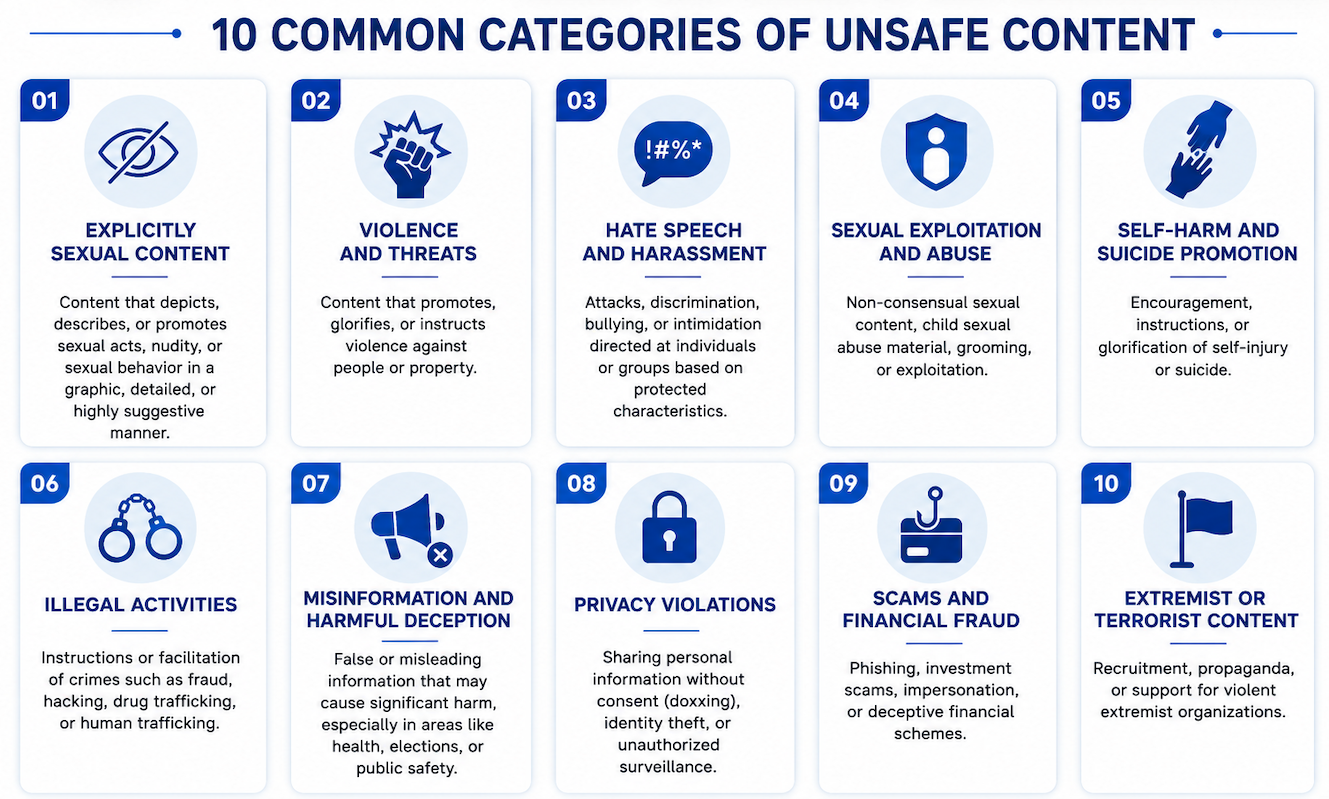
Common Categories of Unsafe Content
Unsafe content includes a broad range of digital material that can negatively impact users. Categorizing such content is essential for developing effective policies, building moderation tools, measuring enforcement effectiveness, and tracking progress in content safety efforts. Some of the most widely recognized categories of unsafe content include:
Unsafe Content Modalities
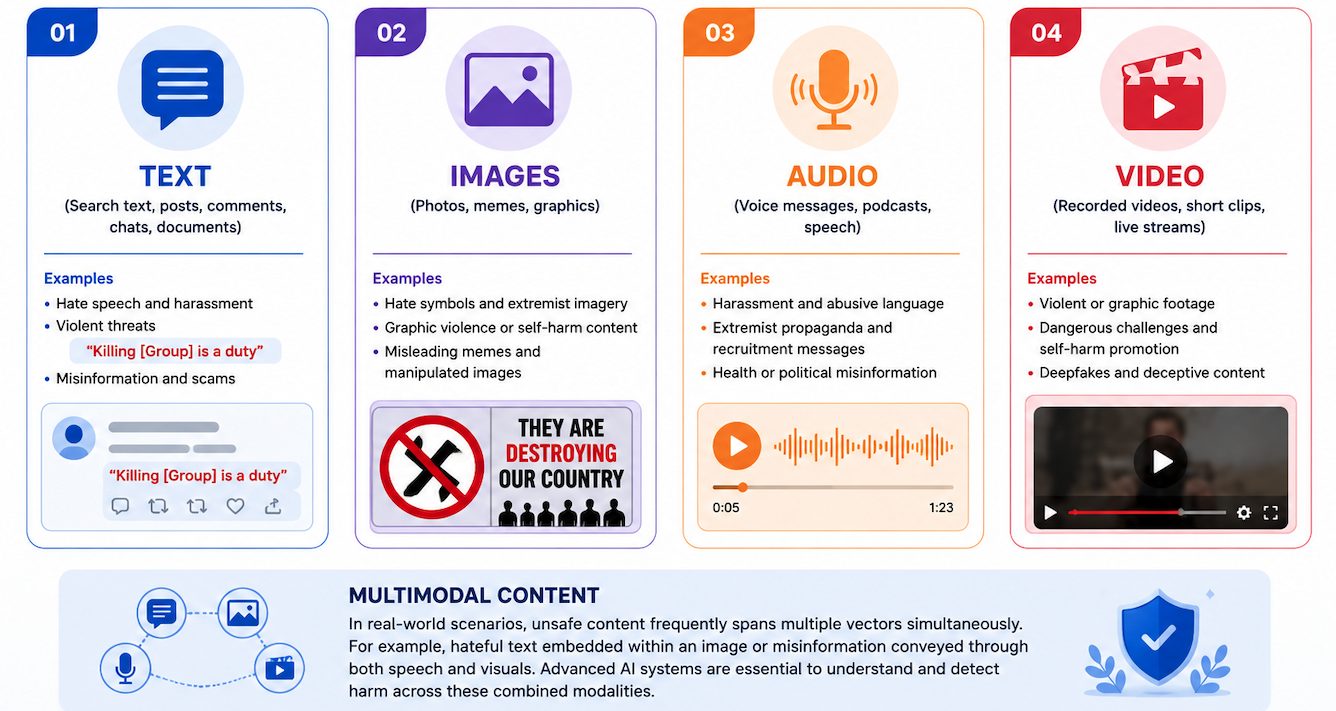
Unsafe content can be created and shared through multiple forms of digital media: text, images, audio, video, or a combination of these modalities. In practice, unsafe content frequently spans multiple modalities simultaneously (e.g., hateful text embedded within an image or misinformation conveyed through both speech and visuals). Understanding these modalities is critical for designing effective content safety systems.
Design Considerations for Content Safety Systems
The design of an effective content safety system begins with identifying the content modalities to be moderated, defining what constitutes unsafe content, and understanding the product and operational requirements that shape the system's architecture, detection strategies, and enforcement mechanisms.
Signals for Content Safety Assessment
The determination of whether content is unsafe is typically based on the content itself, but may also require consideration of context, audience, and behavioral signals associated with the creator. Accordingly, content safety decisions can be broadly grouped into the following categories:
-
Content-only assessment: The content itself provides sufficient evidence to determine whether it violates platform policies. These cases are often the easiest to moderate because the violation can be identified from the content in isolation.
Examples:- An image containing explicit nudity.
- A video depicting graphic violence.
- A text post containing a direct threat against an individual or group.
-
Content and context assessment: Certain types of harmful content can only be accurately assessed when viewed within the appropriate context. The same text, image, symbol, or gesture may be innocuous in one setting yet harmful in another. While contextual signals can greatly improve detection accuracy, they also add significant complexity and raise additional considerations around computational cost. Accurate assessment often requires an understanding of platform-specific context, conversational history, user interactions and relationships, and relevant cultural nuances.
Examples:- Images, symbols, or gestures whose meaning depends on cultural, historical, or conversational context.
- "They don't belong here." is ambiguous but in the context of a conversation targeting immigrants, a religious group, or an ethnic minority, it may constitute hate speech.
-
Creator behavior and intent assessment: In some cases, the primary safety signal lies not in the content itself but in the creator's behavior. Patterns of activity can reveal harmful intent that is not evident from any single piece of content. Consequently, identifying malicious actors and abusive behavioral trends can be more effective than content-level moderation alone. However, leveraging behavioral signals increases system complexity and raises additional considerations around computational cost, data management, and privacy.
Examples:- Repeatedly collecting and sharing images of minors or individuals in ways that suggest sexualization or exploitation.
- Persistent harassment of a target through a sequence of individually non-violating messages.
- Attempts to evade moderation systems through repeated creation of near-duplicate content.
Product and Operational Considerations
The design of a content safety solution is shaped by multiple factors, including the frequency and severity of harmful content, platform scale, enforcement latency requirements, and the trade-offs between accuracy, complexity, coverage, and cost.
-
Prevalence and Severity: Different categories of unsafe content vary significantly in frequency and potential harm. While some violations, such as sexual content, may occur at massive scale, others, such as child safety violations or self-harm, may be rare but require extremely high detection accuracy due to their severity and legal implications.
-
Platform Scale: The volume of content processed per day directly impacts architectural choices. Solutions that work effectively at thousands of content items per day may not scale for handling millions or billions of daily interactions.
-
Enforcement Latency: Moderation may occur in real time before content is published, near real time within seconds or minutes of posting, or offline through batch processing for more comprehensive and accurate analysis. Latency requirements significantly influence system design and complexity. Modern content safety systems typically combine lightweight real-time detection for immediate protection with more sophisticated offline models for deeper analysis and enforcement.
-
Audience Demographics: The characteristics of a platform's user base—including age groups, geographic regions, cultural norms, languages, and regulatory environments— significantly influence content safety requirements and hence the design. Global platforms must account for cultural differences, local laws, and region-specific abuse patterns when designing moderation policies and enforcement systems.
-
Accuracy and Coverage Requirements: High-severity content categories often demand minimizing false negatives, while less-severe may require minimizing false positives to avoid disrupting legitimate content.
Problem Setup for a Web-Scale Platform
Before diving into specific technical approaches, it is helpful to clearly define the problem we are trying to solve.
Consider a large-scale platform where users create and consume content across multiple modalities, including text, images, audio, and video. This content flows through a variety of product surfaces such as recommendation feeds, search, direct messaging, comments, groups, and communities. A production-grade content safety system operating in this environment must satisfy several key requirements.
Multi-Category Detection
The system must accurately identify a wide range of unsafe content categories, including hate speech, harassment, violence, sexual content, and other policy violations. Each category exhibits different characteristics and often requires distinct detection and enforcement strategies.
Multilingual Support
Global platforms serve users across many countries, languages, and cultures. To provide a consistent and safe user experience, the system must effectively detect unsafe content across all supported languages. The same harmful intent can be expressed in countless linguistic variations, dialects, and slang. For example, a simple phrase such as "I hate you" may appear in dozens of languages and thousands of variations while conveying the same underlying intent.
Web-Scale Processing
Content safety systems must operate at massive scale, processing millions to billions of content items while maintaining high accuracy and reliability. Depending on the use case, moderation may occur either in real time or offline.
Real-Time Moderation
Content is evaluated before publication or immediately after it is created, such as messages, comments, search queries, and social posts. These systems typically require sub-second latency—often in the range of 10 to 100 milliseconds—while supporting thousands of requests per second.
Offline Moderation
Content is analyzed asynchronously after publication to detect more complex forms of abuse or emerging harmful trends. These systems prioritize coverage and accuracy and are often required to process billions of content items within strict operational SLAs.